Showcase
Proof That Structured Worlds Can Become Playable Experiences
The PKT Federation showcase demonstrates the direction behind AMIA: authored game material can become structured, inspectable, and playable world experiences.
This page is not intended to expose implementation details. It highlights capability, direction, and the practical value of turning creative source material into living interactive systems.
Featured Demonstration 1 (release May 12, 2026)
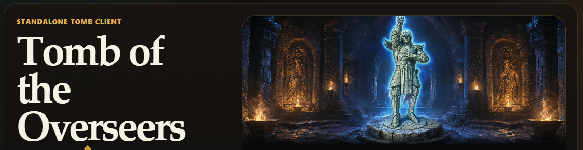
Tomb of the Overseer is a playable technology showcase demonstrating how a bounded adventure setting can be transformed into a navigable experience.
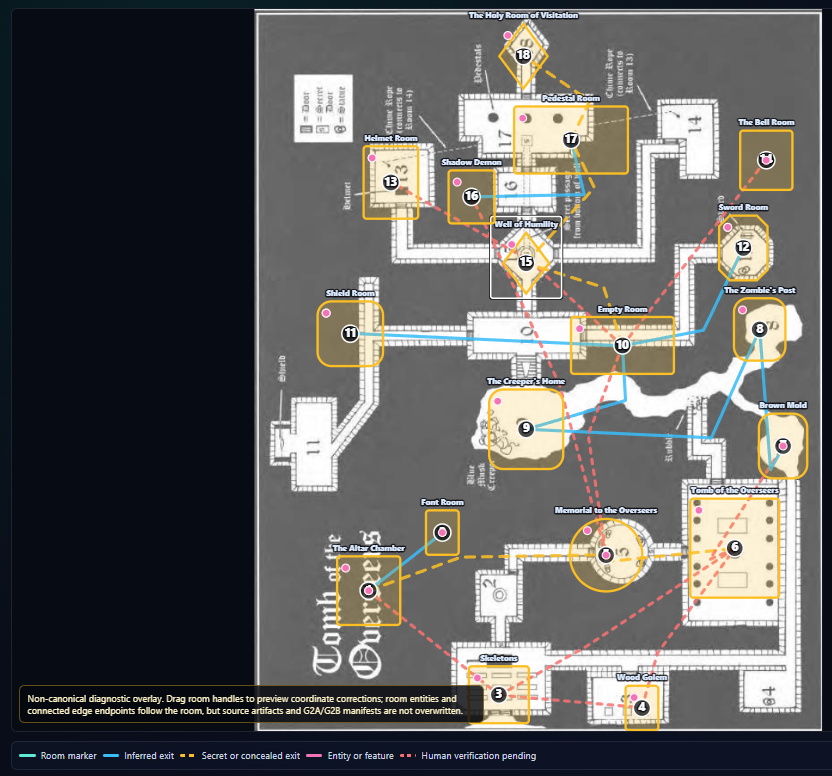
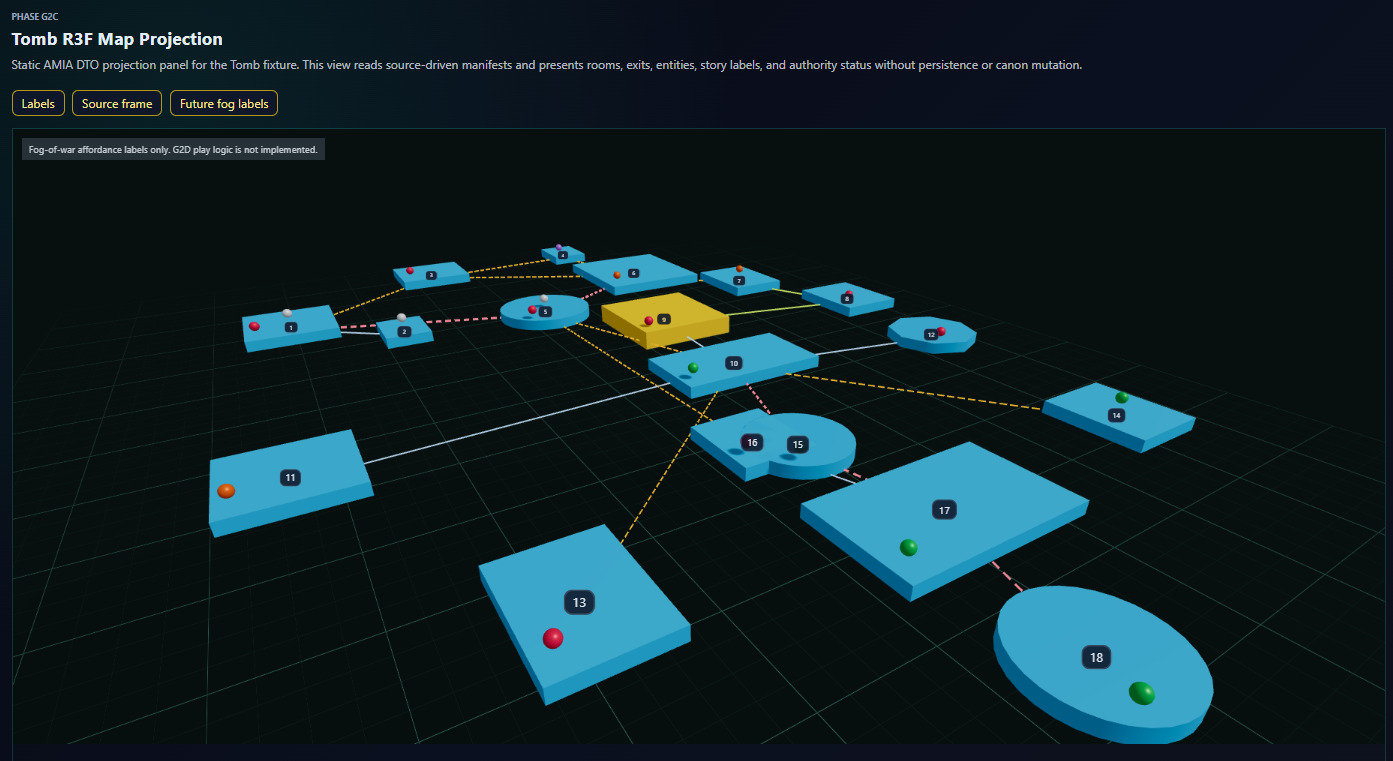
The demonstration shows how source material can be interpreted into a structured world containing locations, connections, encounters, artifacts, and gameplay context.
Launch the Tomb of the Overseer Showcase
What The Showcase Proves
- World structure can be extracted from authored game material.
- Maps and locations can become navigable spaces rather than static references.
- Gameplay context can be organized around rooms, encounters, artifacts, and movement.
- A single structured world can support multiple presentation layers, from simple web clients to richer future experiences.
- AI-ready context can be prepared without requiring the system to improvise outside the world boundary.
Why It Matters For Game Studios
Game studios spend significant time translating design intent into playable form. The showcase points toward a faster, more inspectable workflow where early design material can become a testable foundation.
- Prototype worlds earlier in the production cycle.
- Validate structure before full implementation.
- Reduce ambiguity between design, narrative, and engineering teams.
- Create a foundation for grounded characters, NPCs, and AI-driven interactions.
Featured Demonstration 2 (release August 19, 2026)
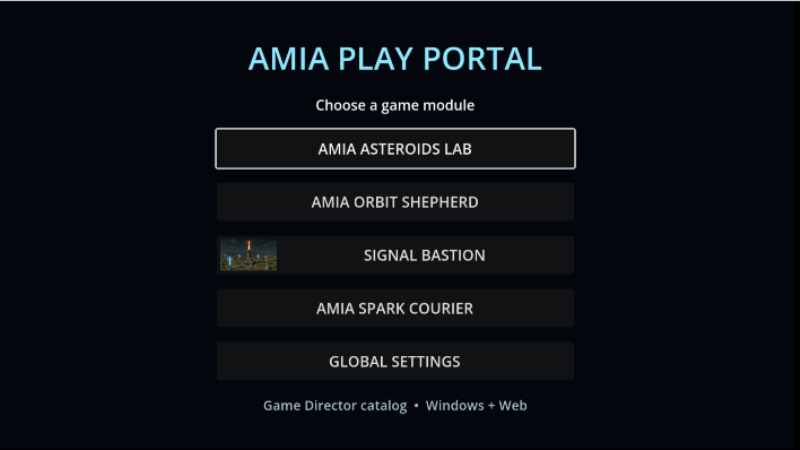
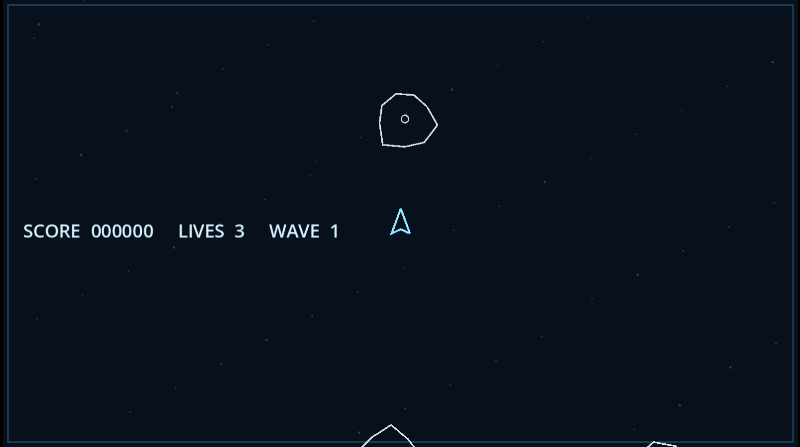
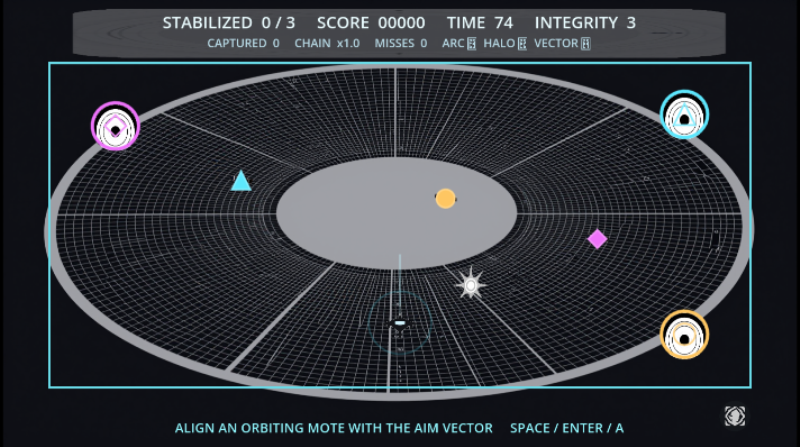
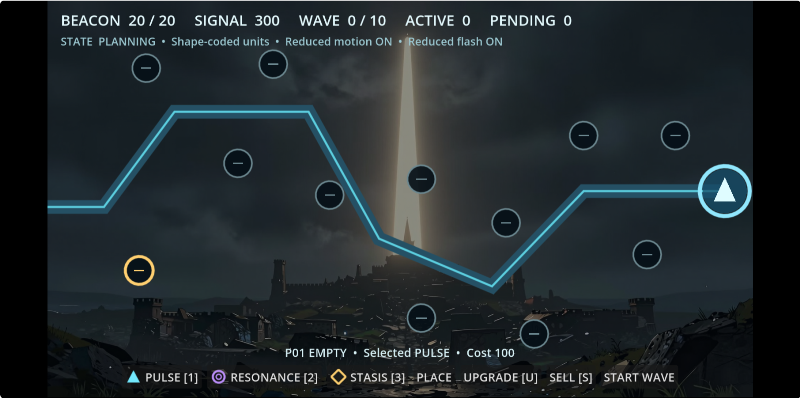
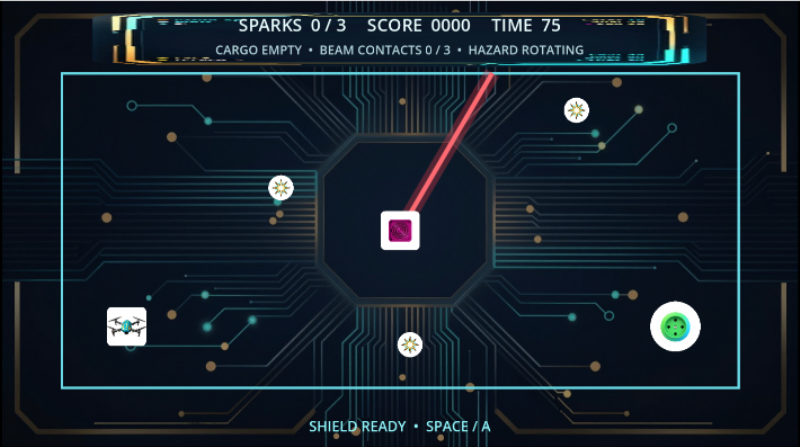
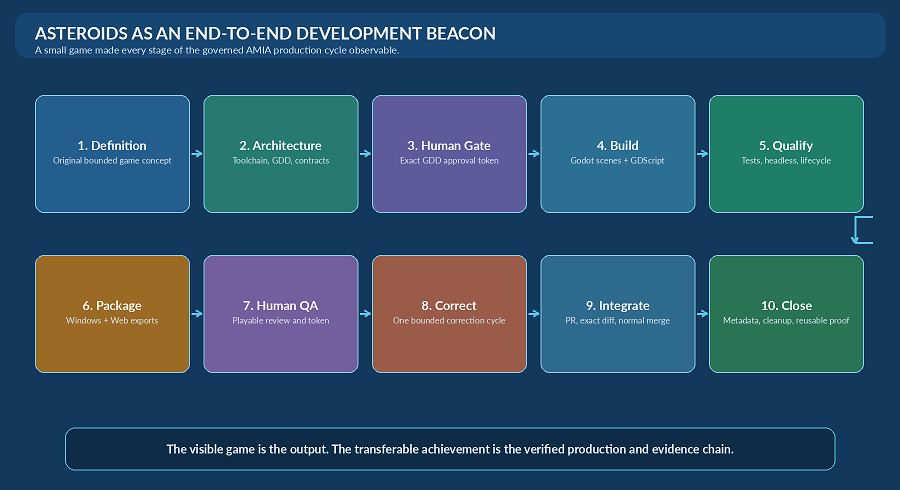
Asteroid Lab is a governed technology showcase demonstrating how a complete production pipeline — from game definition to human-approved release — can be made observable, reusable, and machine-assistable.
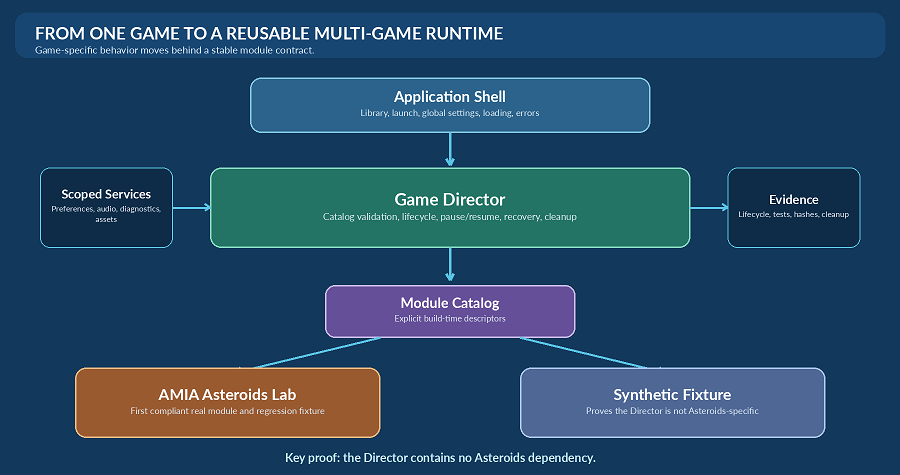
The demonstration shows how a bounded arcade game becomes a repeatable benchmark for testing agency backends, interchangeable execution, asset governance, and modular runtime architecture.
Launch the Asteroid Lab Showcase
What The Showcase Proves
- End-to-end governance is observable — every phase from GDD approval to release closure leaves exact evidence.
- A reusable runtime can host multiple modules without embedding game-specific logic in the application core.
- Execution backends can be interchangeable — the same program contract supports both cloud and local agency workers.
- Qualification is measurable — 28/28 tests, 102 assertions, and 60 lifecycle cycles prove system correctness.
- Release artifacts are verifiable — Windows and Web builds ship with manifests, checksums, and portable launchers.
Why It Matters For Game Studios
Game studios face growing pressure to deliver reliably while integrating AI assistance, remote teams, and content pipelines. The Asteroid Lab points toward a production model where every build, approval, and release is auditable and repeatable.
Where This Is Going
Current showcases are intentionally focused and bounded. Its purpose is to demonstrate the core pattern:
Source material becomes structured reality. Structured reality becomes playable experience.
Future showcases can expand this pattern across richer interfaces, deeper NPC interaction, larger worlds, connected universes, and more advanced simulation layers.
Explore The Platform
- Worlds — what can be built.
- Universes — how worlds scale.
- Agents — who inhabits the world.
- Technology — why the platform works.